11-Minute Hip Mobility Routine for Less Pain at Work
Table of Contents
Sitting through meetings, emails, and focused work can make standing up feel surprisingly difficult. Your first few steps may feel stiff, the front of your hips may feel tight, or discomfort may develop around your hips, glutes, and lower back.
An 11-minute hip mobility routine can help break up that pattern. Rather than aggressively stretching one tight muscle, the routine below moves the hips through several directions while gently activating muscles that help support the pelvis.
The goal isn’t to force your hips into a bigger range of motion. It’s to restore comfortable movement after you’ve spent a large part of the day in one position.
Why Your Hips Can Feel Stiff After Sitting at Work
The hip is a ball-and-socket joint designed to move in several directions. It allows flexion and extension, internal and external rotation, and movement from side to side.
Desk work doesn’t ask for much of that range.
While you’re sitting, your hips remain flexed for extended periods. Hospital for Special Surgery notes that prolonged sitting places the hip flexors in a compressed position and can contribute to tightness. The hip flexor group includes the iliacus, psoas major, rectus femoris, and sartorius.
That doesn’t mean your hip flexors have permanently “shortened” because you spent an afternoon at your computer. The sensation of tightness is more complicated than muscle length alone. Your position, activity level, muscle strength, joint mobility, and individual anatomy can all influence how your hips feel.
The bigger issue for many office workers is lack of movement variety. You may spend several hours with your knees and hips bent at approximately the same angles. Then you suddenly ask your hips to extend when you stand, rotate when you turn, and stabilize your pelvis when you walk.
Regular movement breaks can help. Mayo Clinic recommends breaking up prolonged desk work with stretching and other physical activity to reduce stiffness and discomfort.
The 11-Minute Hip Mobility Routine
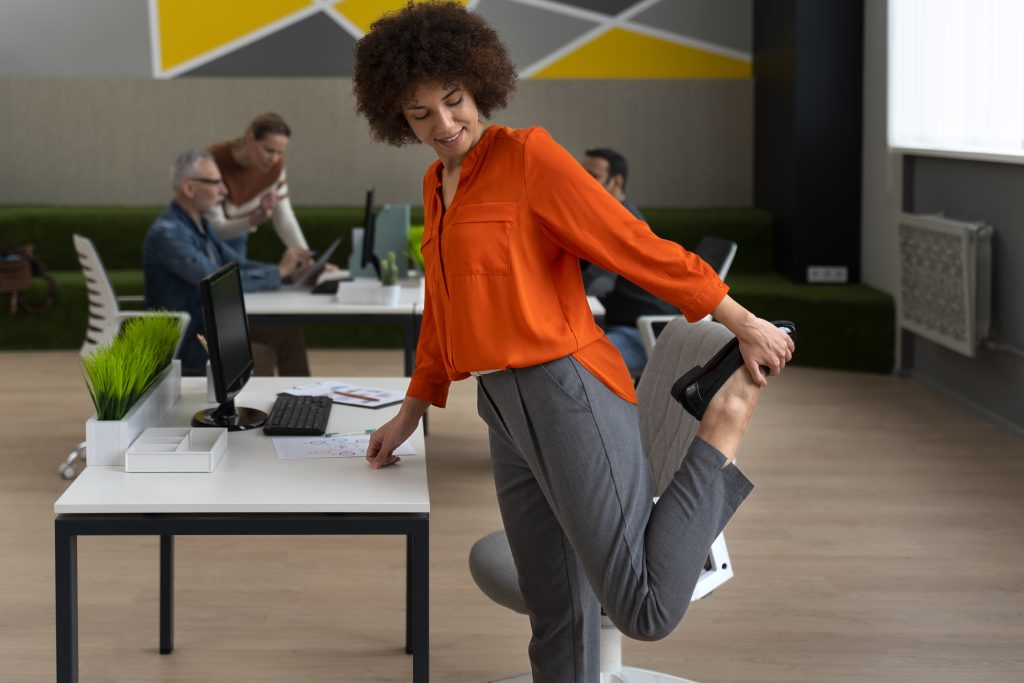
This routine is designed for general stiffness associated with prolonged sitting, not for treating a diagnosed hip injury. You’ll need a little floor space and, optionally, a folded towel or exercise mat.
Move slowly and stay within a comfortable range. You should generally feel gentle muscular effort or stretching, not sharp pain, pinching, catching, or increasing joint pain.
Minute 1: Standing Pelvic Tilts
Start by standing with your feet approximately hip-width apart. Keep your knees relaxed rather than locked.
Gently tilt your pelvis forward, allowing a small arch to develop in your lower back. Then reverse the movement by lightly tucking your tailbone underneath you.
Move between the two positions slowly for one minute.
The movement should be subtle. You’re not trying to create the largest possible pelvic tilt. Instead, you’re reconnecting movement between the pelvis and lower spine after sitting in a relatively fixed position.
Keep your shoulders relaxed and breathe normally.
Minutes 2-3: Standing Hip Circles
Place your hands on your hips and make slow circles with your pelvis. Imagine you’re drawing a circle with your belt buckle.
Spend about 30 seconds moving clockwise, then 30 seconds counterclockwise. Repeat the sequence once.
Keep the circles controlled. Your knees can bend slightly as your weight shifts between your feet.
Hip circles introduce movement in several directions instead of treating mobility as purely a forward-and-back problem. That makes them a useful transition between prolonged sitting and more focused mobility exercises.
If large circles feel uncomfortable, make them smaller.
Minutes 4-5: Half-Kneeling Hip Flexor Stretch
Move into a half-kneeling position with your right knee on the floor and left foot in front of you. Place padding underneath your knee if necessary.
Keep your torso upright. Lightly tuck your pelvis underneath you, then shift forward only until you feel a gentle stretch through the front of your right hip or upper thigh.
Avoid compensating by dramatically arching your lower back. If you have to lean or arch substantially to feel the stretch, reduce your range.
Hold for approximately 45 seconds, relax briefly, and switch sides. Use the remaining time to repeat whichever side feels stiffer, without forcing the position.
A half-kneeling stretch targets the front of the hip, which can feel particularly stiff after prolonged sitting. HSS includes this movement among its recommended stretches for tight hip flexors.
Minutes 6-7: 90/90 Hip Rotations
Sit on the floor with your knees bent and feet slightly wider than hip-width apart. Place your hands behind you for support.
Slowly lower both knees toward your right side. Bring them back toward the center and lower them toward your left.
Continue alternating for two minutes.
Don’t worry about getting both knees to the floor. The useful part of this exercise is controlled rotation, not achieving a specific position.
Your hips need rotational mobility for everyday activities such as walking, changing direction, getting into a car, and turning away from your desk. Because typical desk sitting provides little rotational movement, deliberately practicing comfortable rotation can add movement variety to your day.
If the floor position is uncomfortable, perform a seated version from a sturdy chair by gently rotating one thigh inward and outward at a time while keeping the movement controlled.
Minutes 8-9: Glute Bridges
Lie on your back with your knees bent and your feet flat on the floor. Position your feet approximately hip-width apart.
Gently brace your abdomen, press through your feet, and squeeze your glutes as you lift your hips. Stop when your body forms a comfortable line from your shoulders toward your knees. You don’t need to push your hips as high as possible.
Pause briefly, then lower slowly.
Continue performing controlled repetitions for two minutes, resting whenever necessary.
This part of the routine deliberately shifts from mobility into muscle activation. Your glutes contribute to hip extension and pelvic control, so getting them involved can be useful after spending hours with your hips flexed.
Hip mobility shouldn’t be treated as stretching alone. HSS specifically includes glute and core strengthening among strategies that can support hip strength and mobility.
Minute 10: Seated Figure-Four Stretch
Sit toward the front of a stable chair that doesn’t have wheels. Place your right ankle over your left thigh.
Keep your back relatively straight and gently hinge forward from your hips until you feel a stretch around your right glute. Hold for approximately 25 to 30 seconds, then switch sides.
Don’t press your knee downward. Let the hip open only as far as it comfortably allows.
HSS recommends a similar seated figure-four position for stretching the glute area. If your mobility is limited, simply placing the ankle over the opposite leg without leaning forward may provide enough of a stretch.
Minute 11: Walk
Finish by standing up and walking.
You don’t need a treadmill or a long hallway. Walk around your office, circle your room, or walk to get some water.
Let your arms swing naturally and avoid deliberately exaggerating your stride.
This final minute matters because mobility should transfer into normal movement. Instead of completing a stretch and immediately sitting down again, walking gives your hips an opportunity to use the ranges of motion you just practiced.
Why This Routine Mixes Mobility, Stretching, and Activation
A common approach to stiff hips is to stretch the hip flexors repeatedly. That can feel good, but it addresses only part of the problem.
Mobility is your ability to actively move through a usable range of motion. Flexibility describes how far tissues can lengthen or a joint can move under external assistance. The two concepts overlap, but they’re not identical.
That’s why this 11-minute hip mobility routine includes three types of work.
The hip flexor and figure-four stretches expose the hips to gentle sustained positions. Hip circles and 90/90 rotations introduce active movement in multiple directions. Bridges ask the glutes and surrounding musculature to produce force.
Combining these elements can be more practical for desk workers than chasing extreme flexibility. You need enough mobility to stand, walk, squat, climb stairs, and perform everyday movements comfortably. You also need sufficient muscular control to use that mobility.
When Should You Do Hip Mobility Exercises at Work?
You don’t have to wait until your hips feel extremely stiff.
One practical option is to perform the full routine before work, during lunch, or shortly after finishing your workday. You can then use shorter movement breaks during working hours.
You don’t need to repeat the entire 11-minute routine every 30 minutes. A brief walk, a minute of standing, or a few comfortable hip movements can provide a change of position.
Think of the longer routine and shorter breaks as serving different purposes. The routine gives your hips concentrated movement practice. Movement breaks reduce the amount of uninterrupted time you spend in one posture.
Adjust Your Chair to Give Your Hips More Room
Exercise isn’t the only variable affecting how your hips feel.
Your workstation determines the position you’ll maintain for potentially thousands of minutes every month. Small changes can therefore matter.
Avoid sitting in a position where your knees are significantly higher than your hips for long periods. HSS recommends opening the sitting angle so the knees sit below the hips while maintaining an upright posture when trying to minimize hip discomfort while seated.
Your feet should still have stable support. If raising your chair causes your feet to dangle, a footrest may be more appropriate than simply increasing chair height.
Don’t become obsessed with maintaining one “perfect” posture all day, either. Even a well-adjusted sitting position becomes prolonged sitting if you never leave it.
The better ergonomic strategy is usually a comfortable workstation combined with frequent changes in position.
What If a Hip Mobility Exercise Hurts?
Stretching shouldn’t become an exercise in tolerating pain.
A mild stretching sensation or muscular effort can be expected. Sharp pain, deep pinching in the front of the hip, catching, or symptoms that become progressively worse are reasons to stop or modify the movement.
Mayo Clinic advises keeping workplace stretches gentle and notes that pain during stretching can indicate you’ve gone too far.
This distinction becomes especially important when you’re trying to solve persistent hip pain yourself. Hip pain can have many causes, and not every condition benefits from the same exercises. HSS notes that certain hip injuries require a proper diagnosis because routine strengthening or stretching could potentially aggravate the problem.
If one exercise consistently causes discomfort, don’t assume you need to stretch harder. Remove it from the routine and consider having the problem assessed.
When Hip Pain Needs Professional Attention
An 11-minute hip mobility routine is appropriate for general movement and mild stiffness, but it isn’t a diagnostic tool or a substitute for medical care.
Seek medical attention promptly if severe hip pain follows an injury or if you have significant difficulty bearing weight. Persistent symptoms that interfere with sitting, standing, sleeping, walking, or other everyday activities also deserve evaluation.
Pain location can provide clues, but it shouldn’t be used for self-diagnosis. Discomfort around the outside of the hip, groin, buttocks, or lower back can have different causes and sometimes overlapping symptoms.
A physical therapist or other qualified healthcare professional can assess your mobility, strength, gait, movement patterns, and medical history to determine which exercises are appropriate for you.
Make Hip Mobility Part of the Workday, Not Just a Workout

The most useful hip mobility routine won’t completely compensate for eight or more uninterrupted hours in a chair.
Use the 11-minute session as one part of a broader movement strategy. Stand while taking an occasional call. Walk to refill your water. Change your sitting position. Take the stairs when appropriate. Spend a few minutes away from your screen between long blocks of focused work.
These actions don’t need to become workouts. Their purpose is simply to keep your body from spending the entire workday in one position.
Consistency also matters more than forcing additional range. Your hips don’t need to become extraordinarily flexible. They need opportunities to move comfortably and regularly.
An 11-minute hip mobility routine provides a realistic place to start. Combine those 11 focused minutes with brief movement breaks throughout the day, and your hips get something desk work rarely provides on its own: variety.